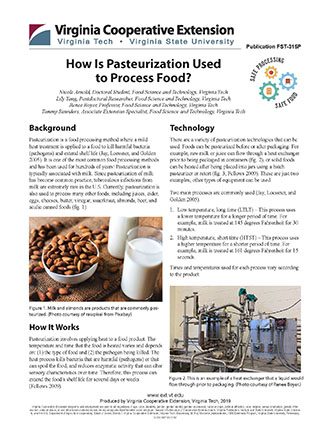
How Is Pasteurization Used to Process Food?
ID
FST-315P (FST-521P)
 EXPERT REVIEWED

Background
Pasteurization is a food processing method where a mild heat treatment is applied to a food to kill harmful bacteria (pathogens) and extend shelf life (Jay, Loessner, and Golden 2005). It is one of the most common food processing methods and has been used for hundreds of years! Pasteurization is typically associated with milk. Since pasteurization of milk has become common practice, tuberculosis infections from milk are extremely rare in the U.S. Currently, pasteurization is also used to process many other foods, including juices, cider, eggs, cheeses, butter, vinegar, sauerkraut, almonds, beer, and acidic canned foods (fig. 1).

How It Works
Pasteurization involves applying heat to a food product. The temperature and time that the food is heated vary and depend on (1) the type of food and (2) the pathogen being killed. The heat process kills bacteria that are harmful (pathogens) or that can spoil the food, and reduces enzymatic activity that can alter sensory characteristics over time. Therefore, this process can extend the food’s shelf life for several days or weeks (Fellows 2009).
Technology
There are a variety of pasteurization technologies that can be used. Foods can be pasteurized before or after packaging. For example, raw milk or juice can flow through a heat exchanger prior to being packaged in containers (fig. 2), or solid foods can be heated after being placed into jars using a batch pasteurizer or retort (fig. 3; Fellows 2009). These are just two examples; other types of equipment can be used.
The most common method of pasteurizing milk in the U.S. is High temperature, short time (HTST). This process uses a higher temperature for a shorter period of time. Milk is treated at 161 degrees Fahrenheit for no less than 15 seconds, followed by rapid cooling (IDFA, n.d.)
Milk can also be pasteurized using a variety of other methods:
- Ultra-pasteurized (UT): Ultra-Pasteurized – This process heats milk to 280 degrees Fahrenheit for 2 seconds. Usually, this allows milk to have a 30-90 day shelf life under refrigeration (U.S. Dairy, 2025)
- Ultra High Temperature (UHT) - This process heats milk to 280 degrees Fahrenheit or higher for at least 2 seconds. Usually, the packaging is airtight, and this process allows milk to stay shelf stable for up to six months (U.S. Dairy, 2025)


Efficacy
Pasteurization can kill at least 99.999 percent of pathogens (a 5-log reduction), reducing 10,000 bacterial cells to virtually nothing. Pasteurization temperatures can also destroy yeasts, molds, and other organisms. Pasteurized foods, when stored properly, can last longer compared to when they are unpasteurized. Pasteurized milk can last 10 to 21 days and up to six months if ultra-pasteurized (Cornell, n.d.). Ultra-high temperature pasteurized milk can last beyond six months (Cornell, n.d.)
Benefits
Pasteurization is used because it increases the safety and shelf life of food with minimal effect on nutrition. However, it can alter the taste of some foods. The process also decreases enzymatic activity such as browning or other undesirable color changes. Currently, there is research in food processing technologies (like irradiation) that “pasteurize” foods without using heat (Fellows 2009).
Current Usage
Pasteurization is one of the oldest and most commonly used processing technologies in the food industry. Although newer, less heat-intensive processes are also being used in place of pasteurization, pasteurization is still an effective and relevant method of processing (Fellows 2009). Consumers wanting to know if the foods they are buying have been pasteurized should look at the label for more information.
Acknowledgements
This work is supported by the Agriculture and Food Research Initiative competitive grant program A4131 (grant No. 2015-69003-23410/ project accession No. 1005440, “Enhancing the Safety and Quality of Fresh Produce and Low-Moisture Foods by Waterless Non-thermal Technologies”) from the USDA National Institute of Food and Agriculture.
References
Cornell. n.d. “Pasteurized versus Ultra-Pasteurized Milk – Why Such Long Sell-By Dates?” https://cals.cornell.edu/sites/default/files/2023-04/pasteurization-fact-sheet-v1.pdf.
Fellows, P. J. 2009. “Pasteurisation.” In Food Processing Technology: Principles and Practice, 3rd ed., 381–94. Cambridge, United Kingdom: Woodhead Publishing.
International Dairy Foods Association (IDFA). n.d. " Pasteurization." https://www.idfa.org/pasteurization.
Jay J. M., M. J. Loessner, and D. A. Golden. 2005. “Food Protection with High Temperatures, and Characteristics of Thermophilic Microorganisms.” In Modern Food Microbiology, 7th ed., 415–41. New York: Springer U.S.
U.S. Dairy. 2025. “UHT Milk: What Is Ultra-High Temperature Milk?” https://www.usdairy.com/news-articles/uht-milk-what-is-ultra-high-temperature-milk.
Virginia Cooperative Extension materials are available for public use, reprint, or citation without further permission, provided the use includes credit to the author and to Virginia Cooperative Extension, Virginia Tech, and Virginia State University.
Virginia Cooperative Extension is a partnership of Virginia Tech, Virginia State University, the U.S. Department of Agriculture (USDA), and local governments, and is an equal opportunity employer. For the full non-discrimination statement, please visit ext.vt.edu/accessibility.
Publication Date
July 17, 2026